 Go back
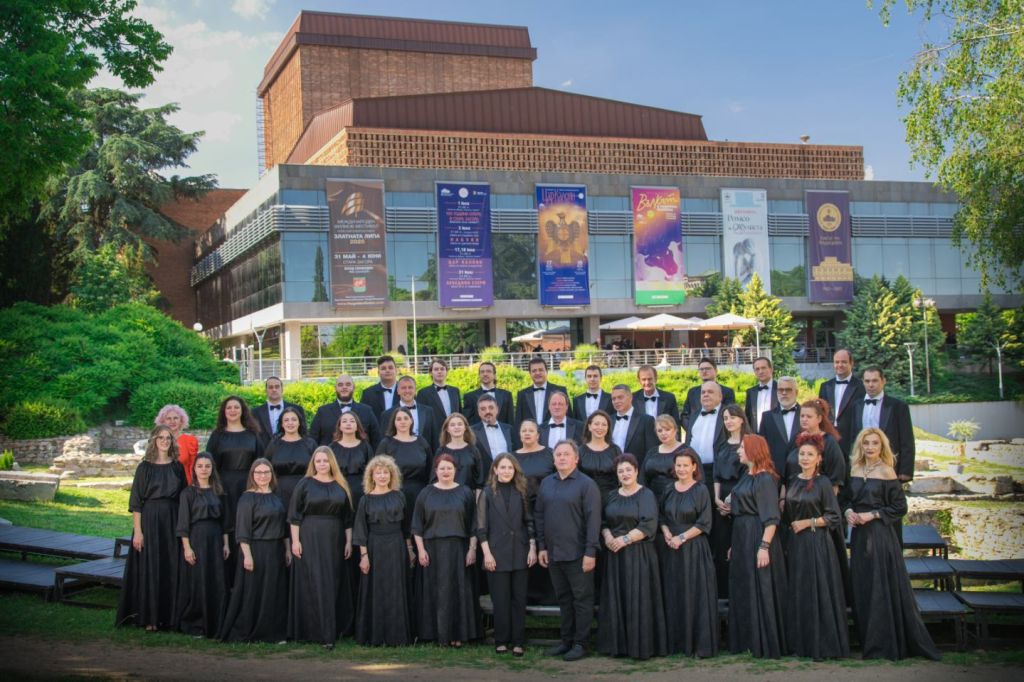
Choir
From the book by Nikola Draganov – History of Opera in Stara Zagora
As early as 1856, the foundations of organized musical life were laid with the establishment of the first church choir at the Church of St. Demetrius by Atanas Ivanov, a teacher at the boys’ secondary school, known among the local population as Daskal Atanas, who was also the choir’s first conductor. The great Apostle of Bulgarian freedom, Vasil Levski, sang in this choir while he was a student at the school, as did the Stara Zagora revolutionaries Kolyo Ganchev—later chairman of the revolutionary committee—Stefan Slivkov, Petar Ivanov (Daskal Petar), and others. This choir, which also rehearsed some secular songs, became the first pioneer in cultivating art music among the citizens of Stara Zagora.
Later, around 1869–1870, in the Akardzha quarter of the city, the first orchestra was formed on the initiative of Daskal Petar Ivanov, a participant in Rakovski’s legion and a flutist, and the revolutionary Kolyo Ganchev, a violinist.
In 1885, the music teacher Georgi Baydanov formed a large male choir at the Church of St. Nicholas in the city (the choir existed until 1890). From 1892 to 1897, Daskal Petko Ikonomov organized a large student church choir that sang at the Church of St. Demetrius.
The beginning of organized musical life and choral activity in Stara Zagora also led to the establishment of the Music Society “Kaval” on November 2, 1897. After the founding meeting, the society formed a mixed choir of about 60 members, with separate women’s and men’s sections, as well as an orchestra of around 40 musicians. The choirs held regular rehearsals under the direction of Georgi Baydanov, and the orchestra was conducted by Dimitar Hadzhigeorgiev.
On April 12, 1898, the society’s first concert was presented in the theatre hall of the Ivan Vazov Boys’ Secondary School, eagerly anticipated by the citizens. The greatest impression was made by the Peasants’ Chorus from Act I of the opera The Bartered Bride by B. Smetana (conducted by Dimitar Hadzhigeorgiev)—the first encounter with “a new and more complex form of music: opera.”
In 1905, Zlatan Stanchev, who had studied music in Odessa and had already conducted choirs in Varna, Svishtov, Sofia, and Ruse, was appointed music teacher at the Girls’ High School in Stara Zagora. He immediately began rehearsals with the choirs of the “Kaval” Society. The society’s activities were discontinued in 1912 due to the three consecutive wars in which Bulgaria was involved.
However, Zlatan Stanchev continued to work with the choir of the Boys’ High School in Stara Zagora, with the school’s string and wind orchestras, and separately with the brothers Dimitar and Boris Hristov, who later became among the finest soloists of the Sofia Opera.
After returning from the front in 1918, Zlatan Stanchev founded a large mixed civic choir within the music section of the “Theatre” Society in the city. By the end of 1919, he presented the operetta The Two Tyroneans by Bordèse. That same year, the Children’s Music Garland “Rodni Zvutsi” (Native Sounds) was established in the city; its choir, which began with 150 children, grew to 300, conducted by Todor Pandev.
In 1922, the foundations of a symphony orchestra were laid, composed of local citizens and musicians from the city’s military wind orchestra.
In 1923, Zlatan Stanchev and Petko Ikonomov revived the activities of the Music Society “Kaval.” Zlatan Stanchev was also the initiator of the founding of the Opera in Stara Zagora, where he worked until the end of his life. He collaborated with it until the end of 1946, when the Opera became a state institution. On December 18, 1946, the Opera ensemble honored him with a benefit performance of Verdi’s La Traviata.
On July 1, 1925, the first opera performance in the city took place—Gergana by Maestro Georgi Atanasov. The choirmaster was Zlatan Stanchev, and the choir consisted of 18 women and 22 men.
Following Zlatan Stanchev, the other choirmasters of the Stara Zagora State Opera throughout its 90-year history—according to the appearance of their names on premiere posters—are:
Tosca by G. Puccini (1937) – director Stefan Makedonski, choirmaster Boris Fetfadjiev
Rusalka by A. S. Dargomyzhsky (1946) – director and choirmaster Georgi Neshev
La Bohème by G. Puccini (1950) – director Hristo Popov, choirmaster Iliya Iliev
Tosca by G. Puccini (1954) – director Georgi Petrov, choirmaster Ivan Dimov
Mam’zelle Nitouche (operetta by Florimond Hervé, 1965) – director Georgi Petrov, choirmaster Bogdana Popova
Orpheus in the Underworld (operetta by Jacques Offenbach, 1978) – director Rumen Neykov, choirmaster Emil Minev
Thaïs by Jules Massenet (1984) – director Georgi Petrov, choirmasters Bogdana Popova and Plamen Genov
Così fan tutte by W. A. Mozart (1996) – director Rumen Neykov, choirmaster Vasil Sheytanov
La Traviata by G. Verdi (2000) – director Nina Naydenova, choirmasters Emil Minev and Mladen Stanev
L’elisir d’amore by G. Donizetti (2002) – director Nina Naydenova, choirmaster Mladen Stanev
Since 2024, Stefania Ruseva, a graduate of the National School of Music and Performing Arts “Hristina Morfova” in Stara Zagora and the National Academy of Music, has also been a choirmaster.
The renowned opera prima and Honorary Citizen of Stara Zagora, Stefka Mineva, has served as a vocal consultant to the choristers of the Stara Zagora Opera for nearly ten years.